
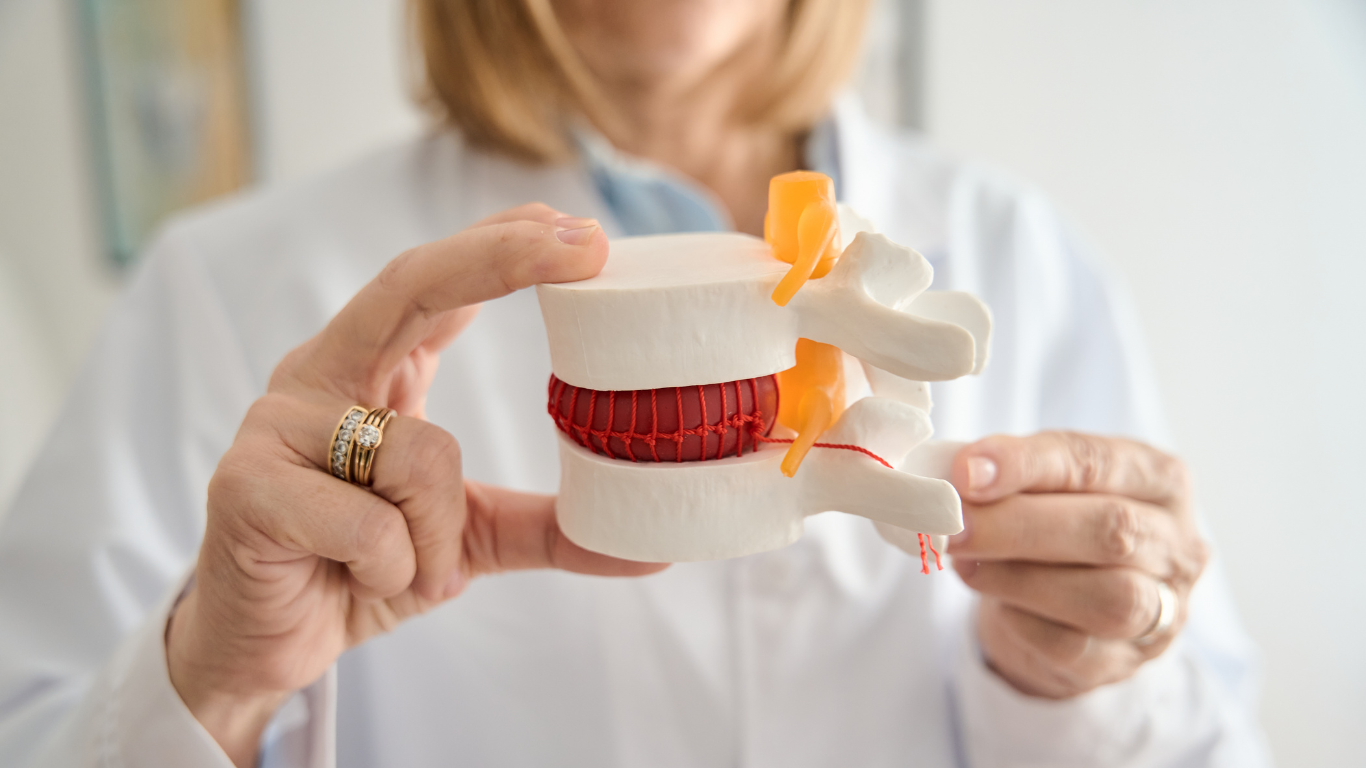

A herniated disc happens when the soft center of a spinal disc pushes outward and irritates nearby structures—sometimes causing back or neck pain, and sometimes radiating pain, numbness, or tingling. At Mountain View Pain Center, we help identify what’s driving your symptoms and build a plan to reduce pain and restore function.
When to Seek Urgent Care
Seek urgent evaluation if you have new or worsening weakness, loss of bowel or bladder control, saddle numbness, severe unrelenting pain after trauma, fever/chills, or rapidly worsening numbness/tingling.
We start by identifying whether your symptoms are consistent with disc irritation and whether a nerve may be involved. Your visit may include a review of your symptom pattern, movement testing, and assessment of the spine, hips, and surrounding muscles. If you have radiating pain, numbness, tingling, or weakness, we may perform a basic neurologic screen. We also check for red flags to determine whether imaging or referral is appropriate.
At Mountain View Pain Center, our multidisciplinary team combines evidence-based care to relieve pain and restore motion:
Targeted diagnostic injections and image-guided procedures when appropriate to reduce inflammation and calm irritated nerves or joints.
Movement-based care to improve mobility, reduce nerve irritation, and rebuild core/hip stability.
Hands-on care to improve joint motion and reduce tension, with techniques selected based on your symptoms and comfort. What chiropractic care for a disc injury involves, and when it is not the first step.
A natural option to support pain relief and relaxation, often combined with your broader plan.
Every Mountain View Pain Center clinic has Pain Management, Physical Therapy, Chiropractic care and Acupuncture in the same building — so if herniated disc needs more than one kind of care, you do not get handed off to another practice.
Colorado: Denver, Aurora, Colorado Springs, Lakewood, Littleton, Highlands Ranch, Lone Tree, Northglenn, Lafayette, Greeley, Fort Collins.
Arizona: Phoenix, Mesa, Chandler, Glendale, Peoria.
No referral is needed in either state. Find your nearest clinic on the full clinic map, or call Colorado (720) 749-5599 or Arizona (602) 325-2024.
This is the fact that should shape your expectations. The body reabsorbs much of the herniated material over time, and large studies show the majority of patients recover well with conservative care alone. Plenty of entirely pain-free people have disc bulges visible on MRI — the image on its own does not decide the treatment. Your symptoms and your examination do.
What that means in practice is a sequence rather than a single decision. Time, activity modification and targeted Physical Therapy come first. If leg or arm pain persists, an image-guided epidural or transforaminal injection can settle the inflammation around the nerve root and often buys the window in which rehabilitation finally works. Surgery — usually microdiscectomy — is reserved for progressive neurological deficit, or for pain that has genuinely failed a well-run course of conservative care.
A lumbar herniation typically causes back pain plus radiating leg pain, with possible numbness, tingling or weakness. A cervical herniation causes neck pain radiating into the shoulder, arm or hand. Pain often worsens with sitting, bending, coughing or sneezing. Seek care immediately rather than waiting if you develop loss of bowel or bladder control, numbness in the groin or inner thighs, or weakness that is getting worse rather than better. For a fuller comparison of the options, see injection versus surgery for a herniated disc.
A disc herniation does not hurt wherever it feels like. The disc presses on a specific nerve root, that root supplies a specific strip of skin and a specific set of muscles, and the resulting pattern is consistent enough that an experienced examiner can usually name the level before anyone looks at a scan.
In the low back, a herniation at the two lowest levels accounts for the large majority of cases. One of them tends to send pain down the back of the thigh and calf to the sole and little toe, and weakens the calf so that rising onto the toes on that leg is harder. The other sends it down the outside of the calf and across the top of the foot to the big toe, and weakens the muscles that lift the foot — which is where a dragging or slapping foot comes from.
In the neck, the equivalent levels send symptoms into the thumb and index finger, or into the middle finger, or into the ring and little fingers, with a matching weakness in the biceps, triceps or grip. This is the reason we ask which fingers, rather than accepting 'my hand'.
The detail that most reliably separates a disc problem from ordinary mechanical back pain is proportion. With a significant herniation, the limb usually hurts more than the spine does. People often say the back itself has eased while the leg has got worse, and assume that means they are improving in one place and deteriorating in another — in fact it is a fairly typical course.
The pain has a distinct character: sharp, electrical, burning, or a deep toothache-like ache, rather than the dull soreness of a strained muscle. Coughing, sneezing, or straining sends a jolt down the limb. Sitting is frequently the worst position for a lumbar disc, and many people find themselves standing through meals and meetings without having decided to.
Numbness in a defined patch and weakness in a specific movement are the findings we care about most, because they are objective and they can be tracked from visit to visit.
The reassuring thing about disc herniations — and it is genuinely reassuring — is that most of them improve without surgery. The extruded material is recognized by the body as something to be cleared, and over months a meaningful proportion of herniations shrink. Symptoms often settle well before any of that shows on a repeat scan, which is one reason repeat imaging is rarely useful for tracking progress.
We are deliberately not quoting you a timeline or a percentage. Published figures vary widely depending on who was studied and how, and an average would not tell you anything about your own leg. What we will do is track the objective findings — the strength, the reflexes, the numb patch, how far you can walk — because those are what tell us whether the direction of travel is right.
The decision point is not how much it hurts on any given week. It is whether the neurological findings are improving, holding, or getting worse. That, and your ability to function, is what moves a case from conservative care toward an interventional step or a surgical opinion. See injection versus surgery for how that choice is actually made.
No referral is needed, and our goal is to get you in within the same week.
The examination is neurological as well as mechanical. We test the strength of the individual muscle groups that each root supplies, check reflexes, map the area of altered sensation, and use the nerve tension tests that reproduce the symptom in a specific position. That is what identifies the level. We also establish a baseline we can measure against — how far you can walk before the leg goes, how long you can sit, what you cannot currently do — so that progress is assessed against something real rather than against memory.
Imaging is ordered when it would change the plan. A scan showing a herniation in someone whose examination does not match it is a trap, and disc bulges are extremely common findings in people with no symptoms whatsoever.
Bring a photo ID and your insurance card, any previous imaging and reports, and a list of what you are taking. If an epidural steroid injection or another interventional step is the right next step, it is performed in office at Northglenn, north Colorado Springs, Mesa and Glendale, and every other clinic coordinates to one of those.
Many disc-related flare-ups improve over time with the right plan. Our goal is to reduce irritation and help you return to normal movement safely.
Sciatica describes nerve symptoms down the leg; a herniated disc is one possible cause. We evaluate symptom patterns to determine what’s most likely.
Not always. If symptoms suggest a need for imaging, we’ll help guide the next step.
It depends on symptoms and severity. Many patients benefit from a coordinated plan that may include PT, Chiropractic care, Acupuncture, and—when appropriate—Pain Management procedures.
Usually no. We typically recommend the right kind of movement and progression based on your symptoms.
Often, no. Some insurance plans require a referral or authorization—if you’re unsure, we can help verify.
Not in the way the phrase suggests. Over time the herniated material shrinks and the inflammation around the nerve settles, and that is usually what the improvement is made of rather than anything sliding back into place.
Most people can, with adjustments to how long they sit, how they lift and how often they move. What those adjustments should be is specific to where the disc is and which nerve is involved.
The same care, written for the metro you are in: herniated disc treatment in Denver, herniated disc treatment in Colorado Springs, or herniated disc treatment in Phoenix.
Each page names the clinics in that metro, what the first visit involves, and where an interventional step would be performed if one is needed.
Herniated Disc is treated at every Mountain View Pain Center clinic in Colorado and Arizona — see the full clinic map, Colorado or Arizona.