

Our Valley clinics, from north Phoenix to Mesa.
If you're living with chronic pain in the Valley, you shouldn't have to drive across town — or wait months — to see a pain specialist. Mountain View Pain Center has our clinics across the Phoenix metro, from Peoria and Glendale in the West Valley to Chandler and Mesa in the East Valley, all reachable at one number: 602-325-2024.
Every clinic offers the same integrated model we built across every clinic in Arizona and Colorado: medical Pain Management, Physical Therapy, Chiropractic care, and Acupuncture under one roof, so your providers coordinate your care instead of handing you off.
Spanish-language communication is available at every clinic through real-time translation.
Same-week appointments are usually available across the Valley.

Our Phoenix-area teams treat the full range of acute and chronic pain conditions, including back and neck pain, sciatica and radiating nerve pain, herniated and bulging discs, joint pain in the knee, hip, and shoulder, arthritis, headaches and migraines, neuropathy, and injuries from car accidents and workplace incidents. If pain is limiting your work, sleep, or time with family, that's reason enough to be seen.
Image-guided injections and interventional procedures are performed on site at Mesa and at Westgate in Glendale. Joint and trigger point injections are performed at every clinic. Our other Valley clinics schedule procedures at whichever of those two is nearer.
How we treat it
Treatment starts with a diagnosis, not a prescription pad. Depending on your condition, your plan may include interventional pain procedures (such as epidural steroid injections, nerve blocks, radiofrequency ablation, and joint injections), a structured Physical Therapy program, Chiropractic adjustments, Acupuncture, or — most often — a combination. Our physicians, including board-certified pain medicine specialists, review imaging, perform a hands-on exam, and build a plan around your goals: less pain, more function, and avoiding surgery where possible.
Auto accidents and work injuries
Phoenix-area patients come to us after car accidents and on-the-job injuries every day. If you’re searching for a car accident doctor or auto injury chiropractor in Phoenix, Chandler, Mesa, Peoria, or Glendale, our team evaluates motor vehicle accident injuries — whiplash, back and neck pain, headaches — usually within days, not weeks. We document your care thoroughly from the first visit, and we handle workers’ compensation claims. Read more about car accident Chiropractic care and personal injury Chiropractic care. If you were just in an accident, don’t wait for the soreness to “work itself out” — early evaluation matters both for your recovery and for your records.
Insurance
We accept most major insurance plans — including Medicare, AHCCCS (Pain Management only), Blue Cross Blue Shield of Arizona, UnitedHealthcare, Cigna, and Aetna — as well as personal-injury liens and workers' compensation. Call 602-325-2024 and our team will verify your benefits before your first visit.
Our approach reflects the Mountain View model: precise diagnosis first, conservative and interventional options weighed honestly, and treatment plans built around your function — not just your pain score.
What patients say
“I had a great experience at the Pain Center. The staff is incredibly friendly and welcoming, which made every visit enjoyable. Everyone there creates a positive and comfortable environment, and you can tell they genuinely care about their patients. The PT and chiropractor were especially helpful and made a big difference for me. They took the time to listen, explain things clearly, and work through treatments that actually helped improve how I was feeling.”
- Jordan V., treated at our Chandler Office.
“Everyone is wonderful, happy, and helpfull. They perform at the best they can. The lady’s in the front are the best they answer questions out any hesitation and welcome you with open arms. I recommend people to come hear if they are in pain or have gotten into a car accident.. p.s give these people a raise 🙌”
- Christopher M., treated at our Glendale Office.
Already been told you need surgery? Get a second opinion on a surgery recommendation — our physicians review the non-surgical, in-office options first.
Back and neck pain are the two most common reasons Phoenix patients call us, and also the two most commonly mistreated. The examination comes first. We want to know whether your low back pain is discogenic, facet-mediated, sacroiliac or muscular, and whether your neck pain is a cervical facet problem, a disc, or a nerve root — because each responds to something different, and treating them all the same way is why so much back and neck pain never resolves.
If conservative care is the right first step, Physical Therapy and Chiropractic are in the same building and read the same chart. If the exam and imaging point to a specific pain generator, a diagnostic medial branch block or epidural steroid injection both confirms the source and treats it. See lower back pain, upper back pain and neck pain, or our Phoenix pages on low back pain treatment in Phoenix and neck pain treatment in Phoenix.
Pain running from the low back into the buttock and down the leg is a symptom, not a diagnosis. In Phoenix we see it caused by a lumbar disc pressing on a nerve root, by spinal stenosis narrowing the canal, and by piriformis or SI joint problems that mimic it. We localise the level, then treat it — transforaminal epidural injection for confirmed radiculopathy, targeted therapy for the rest. More on sciatica and nerve pain and herniated disc, or see sciatica treatment in Phoenix.
Not every painful joint needs a surgeon, and not every painful joint is the problem. A knee that hurts without a clear knee finding is often a hip or a nerve; lateral hip pain is usually not the hip joint at all; a painful shoulder is sometimes a neck. Our Phoenix-area evaluation separates these before treatment, which may include therapy, bracing, image-guided corticosteroid or viscosupplementation injection, or genicular nerve blocks for arthritic knee pain in patients who are not surgical candidates. See knee pain treatment in Phoenix, knee pain and shoulder pain treatment.
Headaches that start in the neck behave differently from primary migraine and are treatable at the source, so we look for the upper cervical joints and muscles that reproduce your headache before assuming otherwise. Burning and numbness in the feet or hands likewise needs a cause before it needs a treatment — diabetic neuropathy, chemotherapy-induced neuropathy and compressive causes such as lumbar stenosis or carpal tunnel are managed in completely different ways. See headaches and migraines and peripheral neuropathy.
Our clinics across the Valley, all reachable on (602) 325-2024:




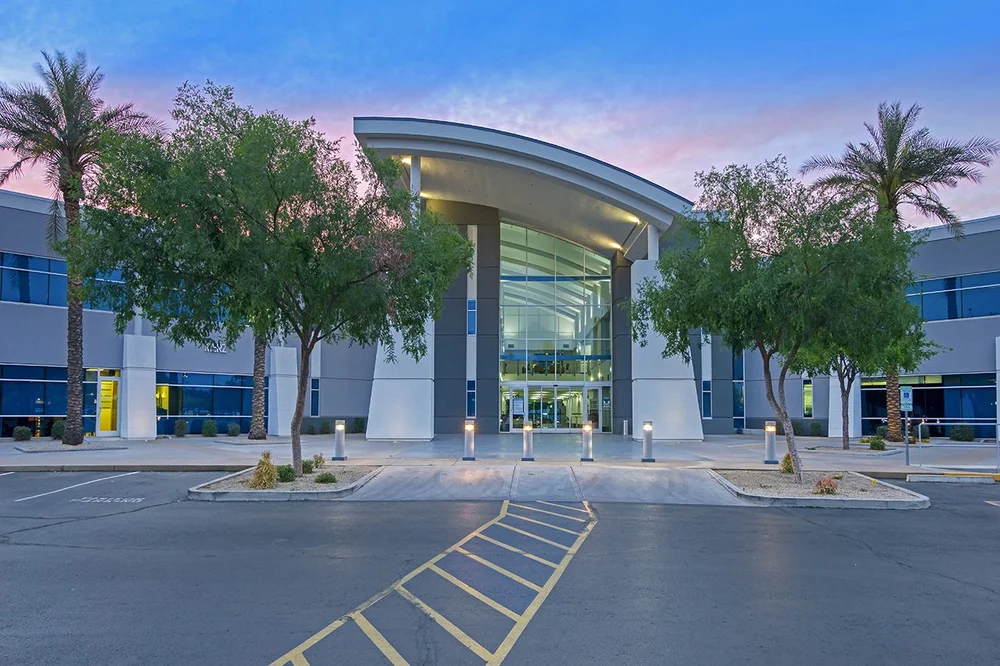
City pages: Pain Management in Peoria, Glendale, Chandler and Mesa.
Hip and groin pain, and what each location of pain points to: hip pain treatment.
Sooner than most people think. If pain has lasted more than six weeks, if it wakes you at night, if it radiates into an arm or a leg, if it comes with numbness or weakness, or if you have been managing it with medication rather than a diagnosis — that is the point where a specialist evaluation changes the outcome. You do not need a referral to book with us in Arizona.
Most patients don't. Some insurance plans require one — call 602-325-2024 and we'll check your plan before you book.
Same-week appointments are usually available at our Phoenix-metro clinics.
No. Our focus is interventional procedures, Physical Therapy, Chiropractic, and Acupuncture — medication is one tool, not the plan.
Whichever is closest — every clinic offers the same integrated services, and your records follow you if you ever switch clinics.
Yes. In many cases we can treat on a lien, so you can start care now and settle the bill when your claim resolves. Care is often billed to auto insurance or med-pay first — call and we'll walk you through it.
Photo ID, your insurance card, any prior imaging (on disc or through a patient portal), and a list of your current medications. If you were injured in a crash or at work, bring your claim number.
Plan for a full evaluation rather than a quick check-in. Your physician will take a history, examine you, review imaging, and leave you with a plan before you go.
No. Many patients only ever see one. The advantage of the integrated model is that if you do need another discipline, it is already in the building and already reading the same chart.
Yes. The focus is non-surgical, opioid-sparing care, escalating only when it is needed.
Yes. If a surgeon has recommended an operation, our pain physicians will review your history and the imaging you already have, and go through the non-surgical options first — injections, Physical Therapy, Chiropractic care and spinal decompression among them. Bring any relevant imaging to the first visit. No referral is needed to be seen.
Usually a physiatrist — a specialist in physical medicine and rehabilitation — or an interventional pain physician. The two overlap. Both work out where pain is coming from and treat that structure, and neither is defined by writing prescriptions. Our page on what a physiatrist is explains the training and what the first visit looks like.
Look for a physician who can examine you, read your imaging and treat the source directly, rather than one whose main job is to pass the problem onward. In the Phoenix area that is our Deer Valley, Dunlap, Mesa, Chandler, Peoria and Westgate clinics, with interventional procedures performed in office at Mesa and Westgate. If the examination points to Physical Therapy, Chiropractic or Acupuncture as the right place to start instead, those are part of the same practice.
Treatment follows the diagnosis. A diagnostic block numbs one structure at a time, and the response tells us which one is producing the pain before anything longer-lasting is done.
Non-surgical spinal decompression on a traction table is available at every one of our Phoenix-metro clinics. It is delivered under Chiropractic care rather than by the Pain Management physicians, and Medicare does not cover it, so we quote you the cost before you start.
Fluoroscopy is on site at Westgate in Glendale and at Mesa, so guided injections at those clinics are placed under live imaging rather than by landmark alone.
Alongside these, Physical Therapy, Chiropractic care and Acupuncture run in the same Phoenix-area clinics, so a plan can move between them without a new referral or a repeated history.
Board-certified Pain Management physicians and physician assistants see patients across our Phoenix-area clinics, working alongside the chiropractors, physical therapists and acupuncturists in the same building. You can see who practices where on our Arizona Pain Management providers page, or browse the full provider directory.
Crash injuries follow a different path through the clinic. Arizona is an at-fault state, so treatment is generally billed to the at-fault driver’s liability coverage, to medical payments coverage where you carry it, or on a lien where an attorney is involved — and the documentation is written as the treatment happens rather than assembled afterwards.
See car accident injury treatment in Phoenix for how that works, or read about whiplash treatment and seeing a chiropractor after a car accident.
Conditions: sciatica, herniated disc, low back pain, neck pain, knee pain and neuropathy.
Procedures performed at Mesa and Westgate: epidural steroid injection, radiofrequency ablation, spinal cord stimulator, kyphoplasty and nerve block.
No referral is needed for any of them, and appointments are usually available within the same week.
Crash injuries by city: Mesa, Chandler, Glendale and Peoria.
And the towns around them: Surprise, Sun City, Avondale, Goodyear and Anthem.
Medicare in Arizona: read what to check about a Medicare Advantage plan before you switch, or, if you spend the season here, Pain Management for winter visitors.
First visit in Arizona? Here is what to bring to a first Pain Management appointment — it is a short list.
Pain Management patients in Phoenix are seen by named, credentialed clinicians, and you can read about each of them before you book.
Every clinician listed here has a page setting out their training, what they work with most and where they see patients. The rest of the team is on the Arizona Pain Management providers page.
Pain Management at every Mountain View Pain Center clinic in Arizona and Colorado — see Pain Management or the full clinic map.