

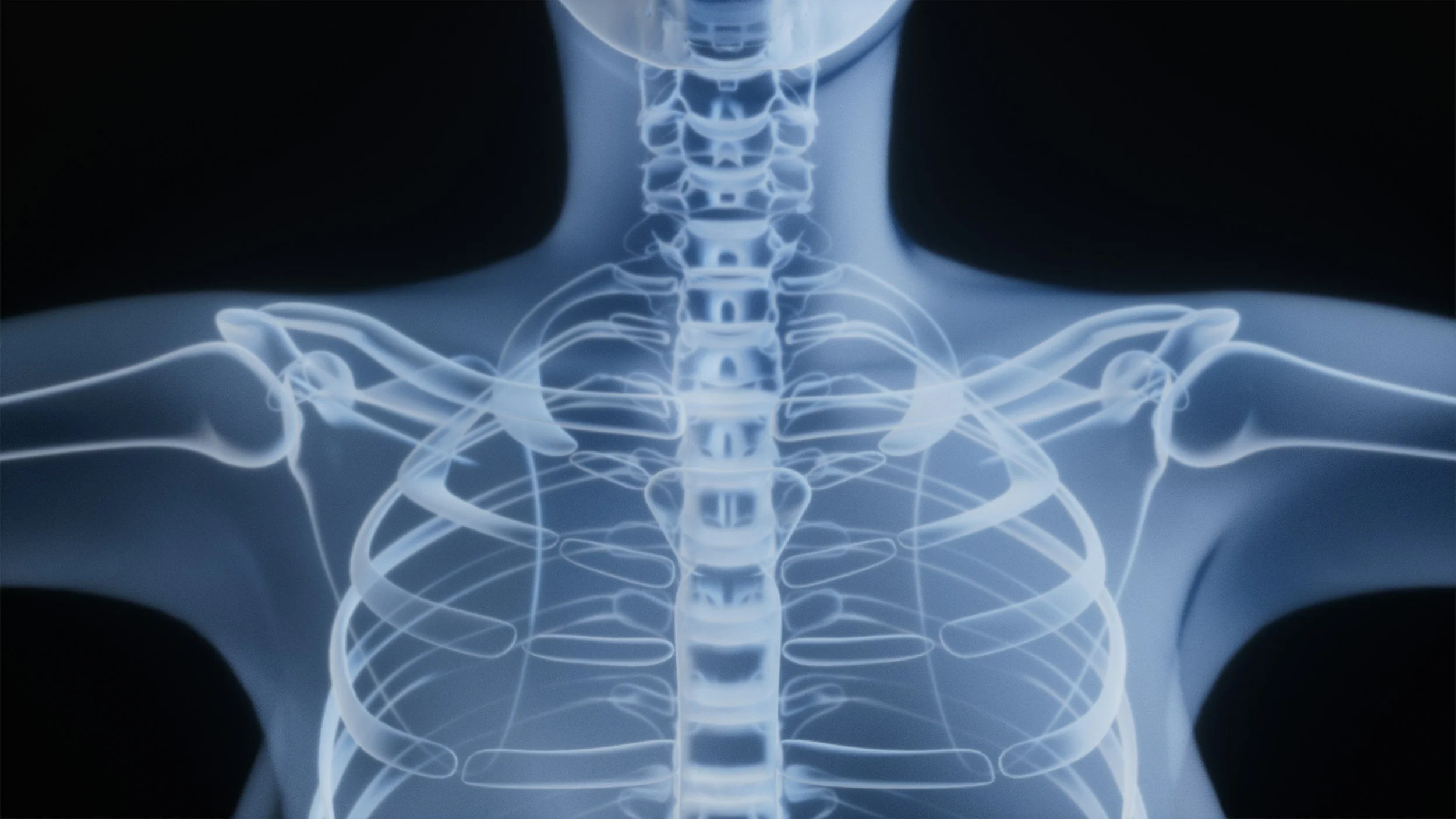
A vertebral compression fracture is a bone in the spine losing height — the front of the vertebra collapses, often in someone whose bone is already thinned by osteoporosis, sometimes after a fall or a crash, sometimes because cancer has weakened the bone. It can happen with no more force than a sneeze or lifting a bag of groceries.
The pain is typically sudden, in the middle or lower back, sharply worse when standing up or rolling over and easier lying flat. Left alone, the vertebra heals in its collapsed shape. Several of them, and the spine curves forward — the stooped posture that costs height, makes breathing harder and makes the next fracture more likely.
Kyphoplasty is percutaneous vertebral augmentation: the work is done through a needle-sized opening rather than an incision, with live X-ray guidance throughout.
A narrow tube is passed into the fractured vertebral body. A balloon goes through the tube and is inflated inside the bone, which creates a cavity and, when the timing is right, lifts some of the lost height back. The balloon comes out and the cavity is filled with bone cement, which hardens in minutes and stabilizes the fracture. The pain relief people describe comes from that stabilization — the broken bone stops moving.
It is not a treatment for osteoporosis itself. Whatever weakened the bone still needs managing afterwards, or the next vertebra is a candidate.
Kyphoplasty is not offered on the strength of back pain and an X-ray showing an old collapse. Medicare sets out what has to be true, and those criteria are a fair description of who actually benefits:
It is also covered for fractures caused by osteolytic metastasis or myeloma, and for traumatic fractures including burst and wedge fractures from a fall or a crash.
It is ruled out where there is active infection or osteomyelitis, or where the pain is clearly not coming from the fracture on the scan. Spinal instability, myelopathy, nerve impingement, canal compromise and more than three fractures at once all count against it. Deciding which of those applies to you is what the consultation and the imaging are for.
The consultation, the imaging review and the follow-up happen at your Mountain View Pain Center clinic. Kyphoplasty is performed at Mountain View Surgery Center, our ambulatory surgery center at 5060 S Syracuse St in Denver, and in office at our procedure clinics in Mesa and Glendale. Either way it is an outpatient procedure with same-day discharge.
You will not be arranging that yourself. Scheduling, the imaging and the surgery center are handled by the same team that sees you in clinic, and questions about a booked procedure go to the surgery center directly on (303) 606-7115.
Most people go home the same day and are asked to take it quietly for the first 24 hours, with no lifting or bending. Relief often arrives within a day or two, though it is not universal and it is not instant for everyone.
The risks are small but they are real, and they are worth hearing before you consent rather than after. Cement can leak out of the vertebral body; usually that causes nothing, occasionally it presses on a nerve. There is a small risk of infection or bleeding, as with any procedure. And stabilizing one vertebra does not stop the next one fracturing — which is exactly why the osteoporosis treatment, the vitamin D and the balance work matter as much as the cement does.
Call us, or seek urgent care, if you get a fever, spreading redness at the site, new weakness or numbness in the legs, or any change in bladder or bowel control.
Kyphoplasty treats a painful vertebral compression fracture — a bone that has collapsed, usually in the setting of osteoporosis, and that still hurts. The word that carries the weight there is 'still'. A fracture that is old, healed, and no longer the source of the pain does not benefit from cement, and imaging that can tell a fresh fracture from a settled one is what decides it, not the fact that a fracture is visible.
So back pain in someone who has had a compression fracture at some point is not automatically a kyphoplasty case. Nor is back pain from arthritic joints, discs, or muscles, even in someone with osteoporosis. We would rather establish which structure is generating the pain than treat the one that photographs most dramatically.
It is deferred where there is an infection, where bleeding risk has not been reviewed, and where the fracture pattern makes the procedure unsafe. Where a fracture may be caused by something other than osteoporosis, that question gets answered first — the answer changes the whole plan, not just this step.
Soreness at the entry site for a few days is usual, and the relief from the fracture pain itself is often noticeable much sooner than that.
The risk specific to this procedure is cement moving outside the vertebra. Most leakage causes no symptoms and is found only on imaging; occasionally it irritates a nearby nerve, and rarely it travels further and causes a more serious problem. Balloon inflation and careful, low-pressure filling under imaging are how that risk is managed, and it is the reason the procedure is done where it is done.
Other risks: infection, bleeding, and a reaction to sedation or anesthetic. There is also a recognized possibility of a new fracture at a neighboring level afterwards, which is partly the procedure and largely the underlying bone — and it is the reason the osteoporosis itself has to be treated alongside, not left for later.
Call us for fever, for new or worsening leg pain or weakness, or for any change in bowel or bladder control. That last one needs emergency assessment.
Kyphoplasty is billed to medical insurance rather than paid for out of pocket. What varies between plans is not usually whether it is covered but what has to be documented first.
Most plans expect a record of conservative care before an interventional step — some combination of Physical Therapy, Chiropractic, medication and time — and many require prior authorization on top of that. This is the main reason a procedure gets delayed, and it is avoidable: the documentation is built as you go rather than assembled in a hurry at the end.
We are in network with most Medicare Advantage plans; call to confirm yours. Workers' compensation is accepted at every location, in both states, across Pain Management, Physical Therapy, Chiropractic and Acupuncture, and auto injury claims are handled through med-pay or a lien we hold directly. Referrals are not required for any of it.
Your benefits are checked in advance — before the visit, not after. Nobody should find out what something costs afterwards. See insurance for the plans each state's clinics bill directly, and ask about any plan that is not listed.
Every clinic below has Chiropractic, Physical Therapy, Acupuncture and Pain Management on one chart, so care can move between them without a new referral.
Downtown out through the north, west, south and east suburbs.
Academy, InterQuest and Tenderfoot cover the north, central and south of the city.
Harmony in Fort Collins and our Greeley clinic serve Larimer and Weld counties.
Across the Valley, from the West Valley through Phoenix to the East Valley.
Both inject bone cement into a fractured vertebra. Kyphoplasty adds a balloon first, which creates a cavity and can restore some of the height the bone lost before the cement goes in. Vertebroplasty injects cement without that step.
The procedure itself is usually under an hour for a single level. Most of the day is checking in, preparation and recovery before discharge. It is an outpatient procedure with same-day discharge.
It is covered when the criteria are met — an acute or subacute fracture, recent imaging within 30 days showing the fracture is still active, and pain that has not responded to proper non-surgical care. We check all of that before scheduling, and we verify your specific plan first.
Timing matters more here than with most procedures. The window Medicare recognizes is the first twelve weeks, and the imaging has to show the fracture is still active. If your back pain started suddenly and has not settled, it is worth being seen sooner rather than waiting it out.
Not to be seen for the consultation. A few insurance plans require one for certain services, which we check when we verify your benefits.
That depends on the case and is confirmed when the procedure is scheduled. Whatever is planned for you, it changes whether you can drive yourself home, so we tell you in advance and ask you to arrange a driver if one is needed.
Not necessarily, but a first osteoporotic fracture makes another more likely, and treating the fracture does not treat the osteoporosis. Bone health management afterwards is part of the plan, not an afterthought.
At Mountain View Surgical Specialists, and in office at our Mesa and Westgate clinics. The Pain Management physician who sees you first is the one who arranges it.
It is performed at our own surgery center or in office rather than referred out: kyphoplasty in Denver (surgery center), kyphoplasty in Colorado Springs (surgery center in Denver), and kyphoplasty in Phoenix (Mesa and Westgate).
Each page sets out who the procedure is for, what the appointment involves, and how it is billed.
Kyphoplasty is offered by our Pain Management physicians in Colorado and Arizona — see the full clinic map, Colorado or Arizona.